Friday, April 16, 2010

Last day in Mali


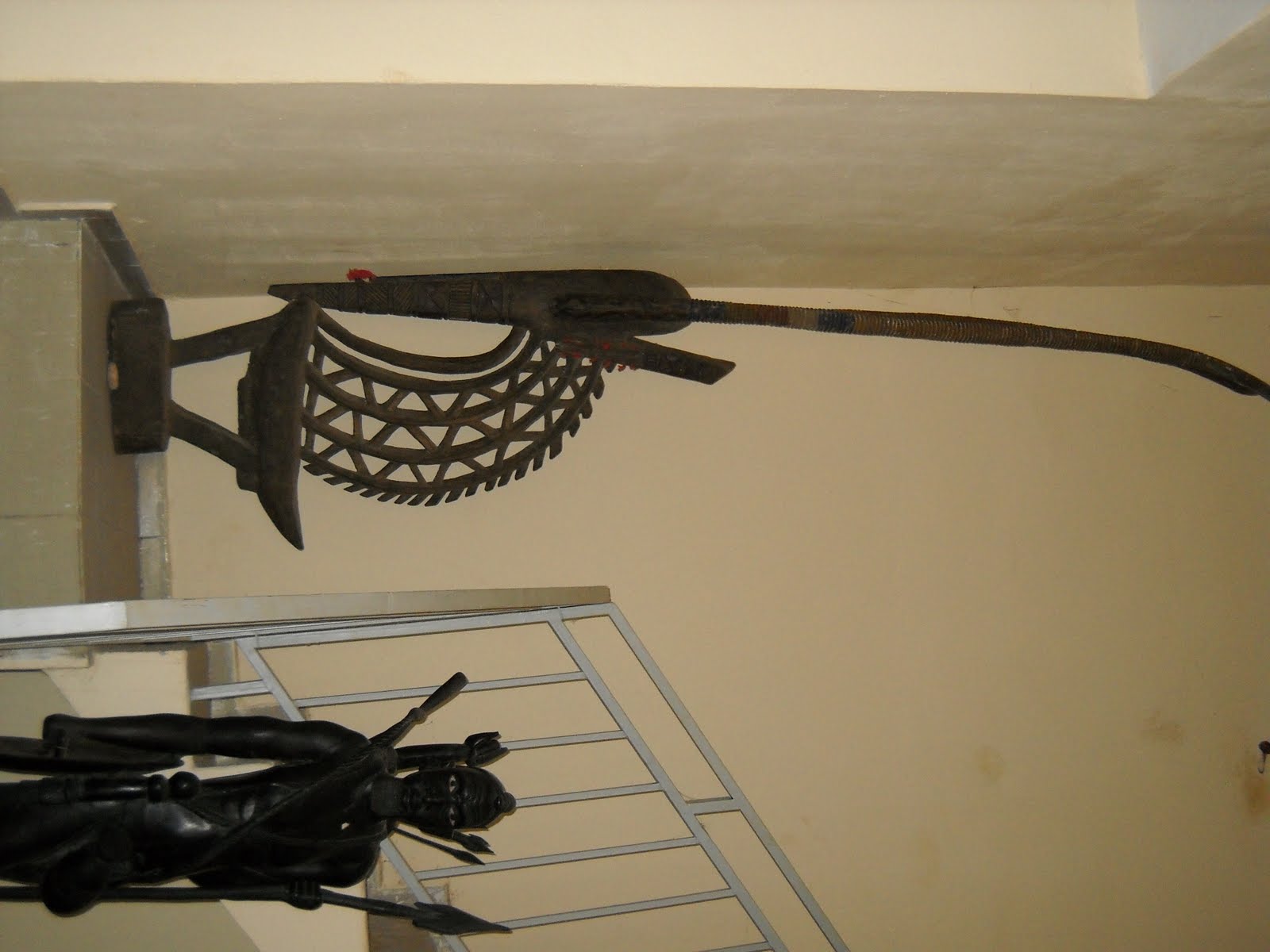
PICTURES: Mother and child, a familiar sight in Mali. The Niger. The museum's take on another familar sight in Bamako---green vans, jammed with people and finally, the National Museum.

We have spent the day touring Bamako. It's a sprawling city with lots of construction going on: buildings, new hotels, bridges. Traffic is a "catastrophe". C'est de la bouillabaise! A useful French expression I picked up here, meaning a mess.

The morning was the market. It is huge, hot, and some of the vendors really hassle you. I am a total failure as a bargainer....in reality, I have no desire for it.

In the afternoon, we went to the National Museum, a beautiful collection of buildings that echo the style of mud brick construction found in the villages. There are verdant gardens surrounding the museum. We saw a great collection of masks and statues, mostly in wood, pottery and the piece de resistance for me, the textiles. Mali was known for its cotton, some of which they transform into Bazin (sp?) in spectacular colours and patterns. There were also beautifully woven wools from the north and the bogolon which is cotton dyed with different hues of soil. Usually, the patterns are geometric. We also had a great lunch in the elegant cafe of the museum and then listened to some Malian music in the late afternoon.

The day was topped off by a beer beside the great Niger river. We watched the sun sink below the horizon. It was stunning......the sky and horizon, two shades of pewter grey, the sun a faintly orange ball. On the topic of beer, before I came here, I figured I would have to abstain for the duration, it being a Muslim country. Many, many Malians (mostly men) drink beer. There is a very high rate of consumption but according to our driver, they do this "en cachette".

I hope this won't offend anyone but I have developed a taste for liver!! Last dinner in Mali was frites and liver. The liver was chopped into pieces sauteed with onions. Often, if you eat in the smaller restaurants, aka cheaper, you end up with whatever they happen to have bought at the market that day.

Hope you are all well. Bye from Mali.

Thursday, April 15, 2010

The Art of Communication


Pictures: First high school in Kolondieba district, built by Save. Sign for the school. Flamboyant tree in the courtyard of the CAP (sort of like the school board)


I have been intrigued by the communication style of the Malians. Now, my experience is mainly limited to Siddi, our driver and Abou, the Save director of the Sahel region. I have been able to observe their interactions most closely. Other observations have been limited to briefer interactions between Siddi and someone he meets in passing or someone he may meet while driving us to the various schools.

Rule number one: You never fail to greet everyone in the room or group with a handshake and, at a minimum, Bonjour, ca va? I noticed that these greetings can go on for a longer time and that there is a definite pattern. One person asks a question, the other sort of mumbles an answer, then that person asks a question and this can go on for a minute or so. Sometimes, when I was meeting someone for the first time, it would go sort of like this....in rapid succession: Bonjour ca va.? (me: oui, ca va. Et vous, ca va) Et la famille? (Why is he talking about my family?? It quickly dawns on me that he is asking about my family!) Et le Canada? Et le sejour a Sikasso and on and on. For Malians, they might cut to the chase and ask, "Et la famille" after the initial bonjour, ca va. Often, though, they will go through all members of the family and ask after them. All this is done quite quickly but for that moment, all your attention is focused on that person.

Rule number two: You don't listen in silence. Abou explained that if you sit quietly and listen to a Malian speak, he will stop dead and ask if something is wrong. So, as we drove to Kolondièba, I listened to their conversation, conducted mainly in Bambara with lots of French thrown in. Sometimes I could get the gist of the conversation because of key phrases in French. I haven't understood Bambara beyond the most basic phrases. As the two of them spoke, I discovered that the listener is expected to participate through murmured agreement, asking short questions, high pitched "eh", laughter, c'est ca! (more agreement), voila! (voice lowered and voila is sort of drawn out---the way a magician might say it). There are no periods of silence while the story is going on. So, their conversation went on in this manner, interspersed with lots of laughs. It was a joy to listen to though I didn't understand most of it.

Rule three: Take time at the end of a transaction or conversation. I think I violated this rule I so crudely described. When I went to the tailor to have the outfit made, he took all my measurements, we discussed the style and detailing. This was followed by the discussion of the price. Siddi did that. He began that by looking straight into the tailor's eyes, a fairly serious look on his face. In this case, the negociations were over quickly. The tailor named a price and Siddi looked at me immediately. Luckily I was fairly quick on the uptake that day and understood immediately that the price was a fair one. So, I accepted and stood to leave. This was the faux pas. I looked at Siddi. He was still sitting, exchanging words with the tailor. It wasn't over.I melted back into my chair. I'm not sure if this is a hard and fast rule but there was something there. No one seemed bothered by the fact that I got up. I haven't confirmed this observation so will let you know if there are any updates.

Wednesday, April 14, 2010

Bloggin'


Okay, so I just figured out how to view comments. So there are lots of comments that friends have posted and it is possible to view by clicking on the comments link at the end of each post.
I think anyone can post comments too if you care to.
Good night!

Sleepless in Kolondièba


We bid our fond farewells to the young staff of the Hotel Maissa in Sikasso and were on our way to conduct a short workshop for teachers in Kolondieba who had previously attended workshops.


I am now familiar with the roll of the countryside. This is quite a green area of Mali, so lots of vegetation. The acacias and flamboyant trees are in bloom so it can be quite pretty, even is this period before the rainy season. We passed the now familiar but still enjoyable to the eye, collection of villages. I am fascinated by the little round grain silos found in all villages, each one a little different from the last.

The town of Kolondieba has electricity for only limited periods of the day. The hotel is a cinder block construction with no running water (today, at any rate). The bucket of water was fine for a shower after the workshop. The idea is that you get to sleep before the power, and therefore the ceiling fan, goes off at 11:30.

I went to bed in sufficient time for a prior to 11:30 sleep. Read for a bit until my eyes got tired. And still, sleep did not come. Sweat ran. The fan wasn't all that effective. Then, the power went out. A thick blanket of air enveloped me immediately. The sweat poured. Visions of the POW imprisioned in the sweat box in the movie, Bridge Over the River Kwai sprung to mind. I had to escape!

Outside, the air was at least 10 degrees cooler. There was a nice breeze. I set up two chairs and listened to the night sounds: the gentle rustling of the trees in the breeze, the distant howling of dogs, a baby crying, the snoring from the room next to me (lucky guy), a group of men talking. The cacophony begins to take off at about 3 am, I estimate, with the donkey wailing and the rooster crowing (non stop). The first call to prayer came at about 4:30. It's 5:10, now, not long now, until sunrise.

Until the next time. Internet access has been spotty so sorry for the delay. Pictures are of iconic baobab tree and me in my Mali original.

Sunday, April 11, 2010

Amadou et Mariam


We had the good fortune to be in Sikasso when the famous Malian musicians, Amadou and Mariam were playing here. They have a website if you want to check them out. http://www.amadou-mariam.com/ They sang at Obama's Nobel Peace prize ceremony last year. They have been singing together for many years since they met in the 70s (?) at the Bamako centre for the blind.


It looked like all Sikasso's glitterati, decked out in all their finery, were there. Many of the expat community as well, less finely decked out. We pale in more ways than one alongside these incredibly elegant people. In reality, the concert was not that well attended, apparently, it was expensive for most people....about $6. The concert was on Mali time....you've heard of Mexican time? Same idea....it started 2 hours late. Despite that, no one got too upset..there were a few grumbles but good humour was restored as soon as they began, finally, to play.

There were some of the usual speeches, thanking important people who helped with the concert (from what I could gather from the mix of French and Bambara); some locals were singled out and rose to polite applause. A curious thing, people from the audience would go on stage, hand Amadou and Mariam money and then have their picture taken, all this while the concert was in progress. Lots of people got up to dance, I among them.

An Oasis in Sikasso


A young friend took me to an exquisite little museum yesterday. The museum, which celebrates and seeks to preserve, Senoufo culture, the main people in this region, was founded by a Spanish priest who came to the area 50 years ago.

The museum contains many stunning artifacts of the Senoufo people and has a gorgeous garden like nothing I have seen in this city. I haven't mentioned this before, but the city is not pleasing to the eye, in the way that Westerners see things. It is a dusty, garbage strewn place. Like lots of places, they have not figured out how to cope with the mountains of garbage and particularly the God forsaken plastic bags that accumulate everywhere. Sikasso doesn't have many paved streets. There is a disorder to things......giant potholes, lean-tos springing up alongside substantial houses. So, the museum was an oasis.

The main mandate of the museum is to educate and to preserve the culture. Père Escudero has been here for 50 years and has recorded the songs, the stories, the dances and rituals of the Senoufo. There are carefully catalogued cassette tapes and videos as well as stories transcribed in Senufo and French. He is working on a Senoufo dictionary. He also is brimming with ideas about the right kind of tourism, creating a sense of pride among the Senoufo, greening Sikasso, dealing with the problem of garbage. It was a real privilege to talk to him.
The PICTURES show(1) the many faces of women. Women are greatly respected in the culture for the many roles they play including fertility. As it was explained to me, you can't really ever know a woman hence the many heads. I took this to mean that women are capricious, however, is was not that.....it is meant to show the many roles women play in the culture. (2) The birdlike statue is used to congratulate someone when they have done a very good job of cultivating the land and (3) the last shows the lovely garden of the museum. http://www.senoufo.com/ is the website of the museum.

Saturday, April 10, 2010

Me,Sir! Me, Sir!


One of the most distracting things for me as a teacher has been the cries of Me, Sir! Me, Sir!, accompanied by the snapping of fingers to get the teacher's attention. Most of the teacher's accept this a normal behaviour.

I think I've mentioned before that most classrooms are jammed with students. I have been in classrooms of 130. The size of the classroom doesn't change; the desks are just closer together and the students sit more to a bench. Most students have a notebook and pen. In none of the seven classes I visited this week, did any of the students have a textbook. The teachers must write everything on the board. Many of them are quite adept at teaching the dialogues, including a lot of student involvement. There is no electricity in any of the village schools. The windows are large and at least a cross breeze is created.

The students are generally very well behaved and obedient. In the city school, I observed a bit more of a swagger and less reverence for the teacher. It was a Friday at 4 pm when I noticed this so maybe to be expected.
The school day starts at 7:45 and goes to 12 noon. There is a half hour break at mid morning. At that time, the children will knock mangoes from the trees and have a conveniently available snack. At the village schools, some of the students will walk for about an hour to get to school. Lunch is from 12 to 3pm, the hottest part of the day, and then classes resume for two hours from 3 to 5 pm.
The pictures are of one village primary school at morning break. The teachers are in the foreground. The other is of Me, Sir! though, in this picture, they are actually saying, Missus! Missus!